GPU-Parallel Linearization Error Bounds for Real-Time Robust Optimal Control of Nonlinear and Neural Network Dynamics

Tight, differentiable, provably sound linearization error bounds integrated into a GPU-accelerated system-level synthesis solver for real-time robust nonlinear MPC.

  • Jeffrey Fang
  • Keyi Shen
  • Anutam Srinivasan
  • Glen Chou
Abstract

Real-Time Robust Control with Certified Reachable Tubes

This paper studies real-time robust optimal control for uncertain nonlinear systems, where linear time-varying approximations make planning tractable but require sound linearization error bounds to guarantee robust constraint satisfaction. GPUSLS-LEO develops tight, differentiable, GPU-parallel bounds for analytic and neural network dynamics, then integrates them into a system-level synthesis robust control solver. The result is online optimization of robust feedback policies that account for linearization error and produce tight, formally verified reachable tubes on nonlinear and learned dynamics.
Challenge

Certified Linearization Error for Real-Time Control

LTV approximations make nonlinear robust optimal control tractable, but their guarantees depend on bounding the gap between the true dynamics and the approximation. The paper targets bounds that are tight enough to reduce conservativeness, fast enough for online planning, and differentiable enough to guide trajectory optimization.

Tight local bounds

Path-based Hessian bounds improve over standard interval methods for analytic dynamics by focusing on the local tube around a nominal trajectory.

Neural dynamics

Verifier-generated affine relaxations with local Jacobian corrections give certified linearization error bounds for learned models.

Robust synthesis

Zonotopic uncertainty propagation handles non-zero-centered disturbance sets and right-invertible disturbance matrices inside SLS.

Method

GPUSLS-LEO combines certified bounds with GPU-parallel control synthesis.

  1. Linearize along the nominal trajectory. Use an LTV surrogate while preserving a certified accounting of the nonlinear residual.
  2. Compute differentiable error bounds. Use path-based bounds for analytic dynamics and verifier-based bounds for neural dynamics.
  3. Propagate zonotopic uncertainty. Represent exogenous disturbance and linearization error with tight reachable tubes.
  4. Optimize robust feedback on the GPU. Alternate nominal trajectory and robust controller updates using the GPUSLS-LEO formulation.
Results

Evaluation Across Analytic and Neural Dynamics

  • Satellite, 7D: average tube widths are 20% smaller than NL-SLS and 45% smaller than ellipsoidal GPUSLS-E while maintaining 100% rollout containment.
  • Planar quadrotor, 6D: position tube area is reported as 91% smaller than a CCM baseline in an obstacle navigation task.
  • Coupled quadrotors, 168D: 14 coupled 3D quadrotors navigate through obstacles with adversarial rollouts contained inside tight tubes.
  • Neural T-pusher, 5D: formally accounting for neural-model linearization error keeps rollouts in the robust tube, unlike GPUSLS without error propagation.

Runtime Breakdown

Per-iteration runtimes stay below the discretization time step across the reported systems, supporting real-time iteration MPC.
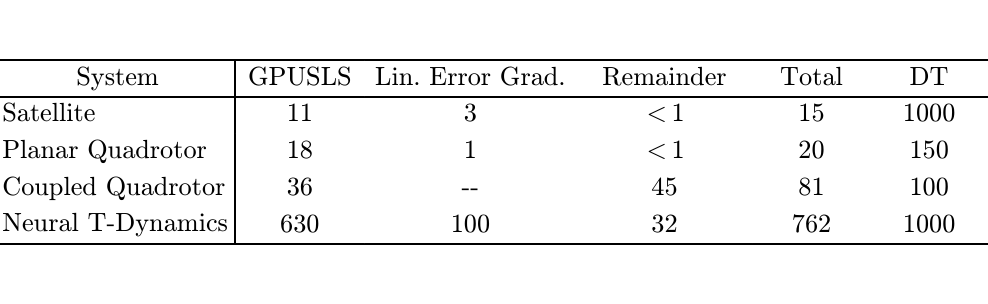
Runtime breakdown table for GPUSLS-LEO experiments
Experiments

Multi-Quadrotor Robust Planning

GPUSLS-LEO scales to a coupled system of 14 3D quadrotors, producing tight tubes while navigating through an obstacle field under adversarial disturbances.
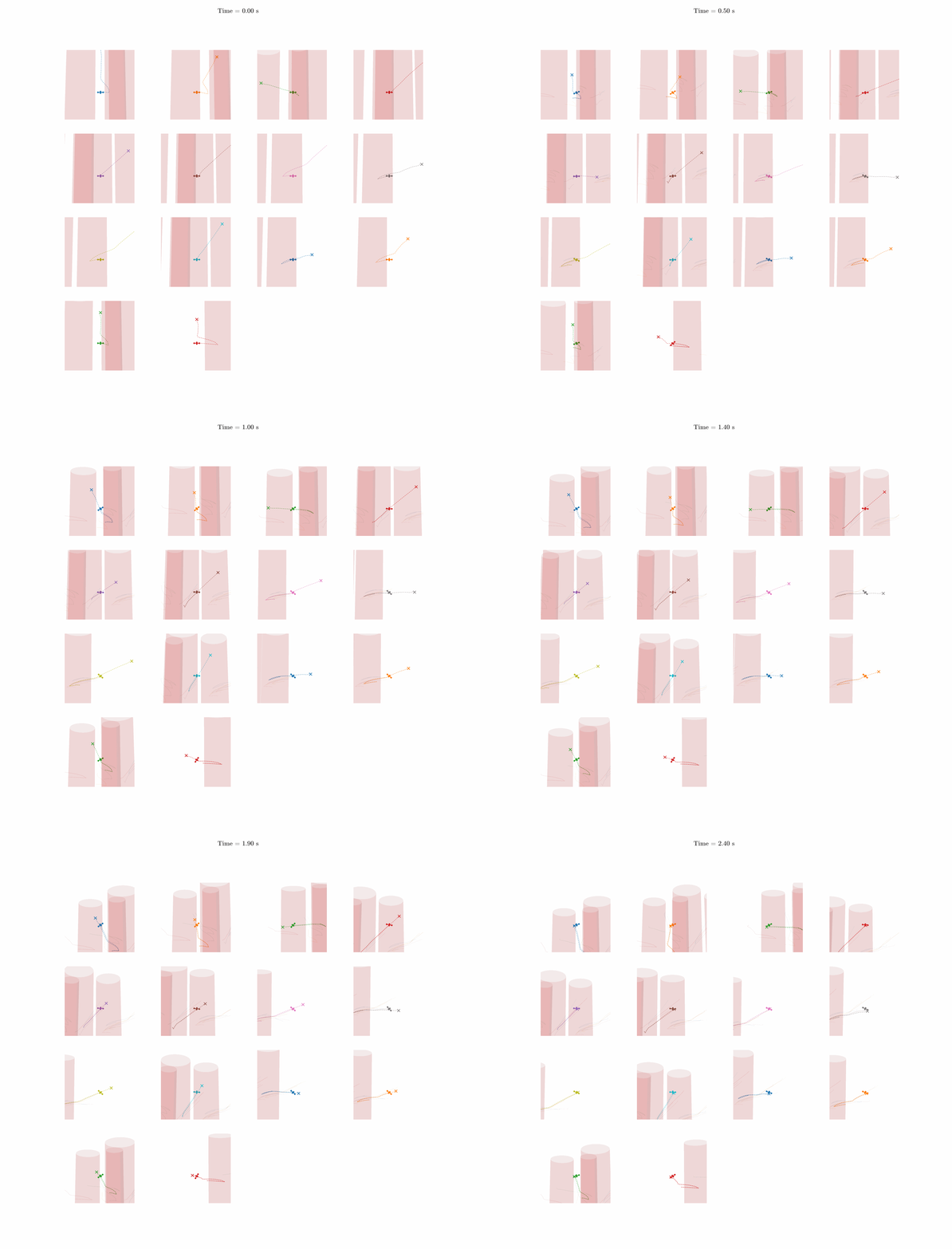
Animated chase views of the coupled multi-quadrotor setup

Chase views

Animated views of the coupled quadrotor team moving through the obstacle field.
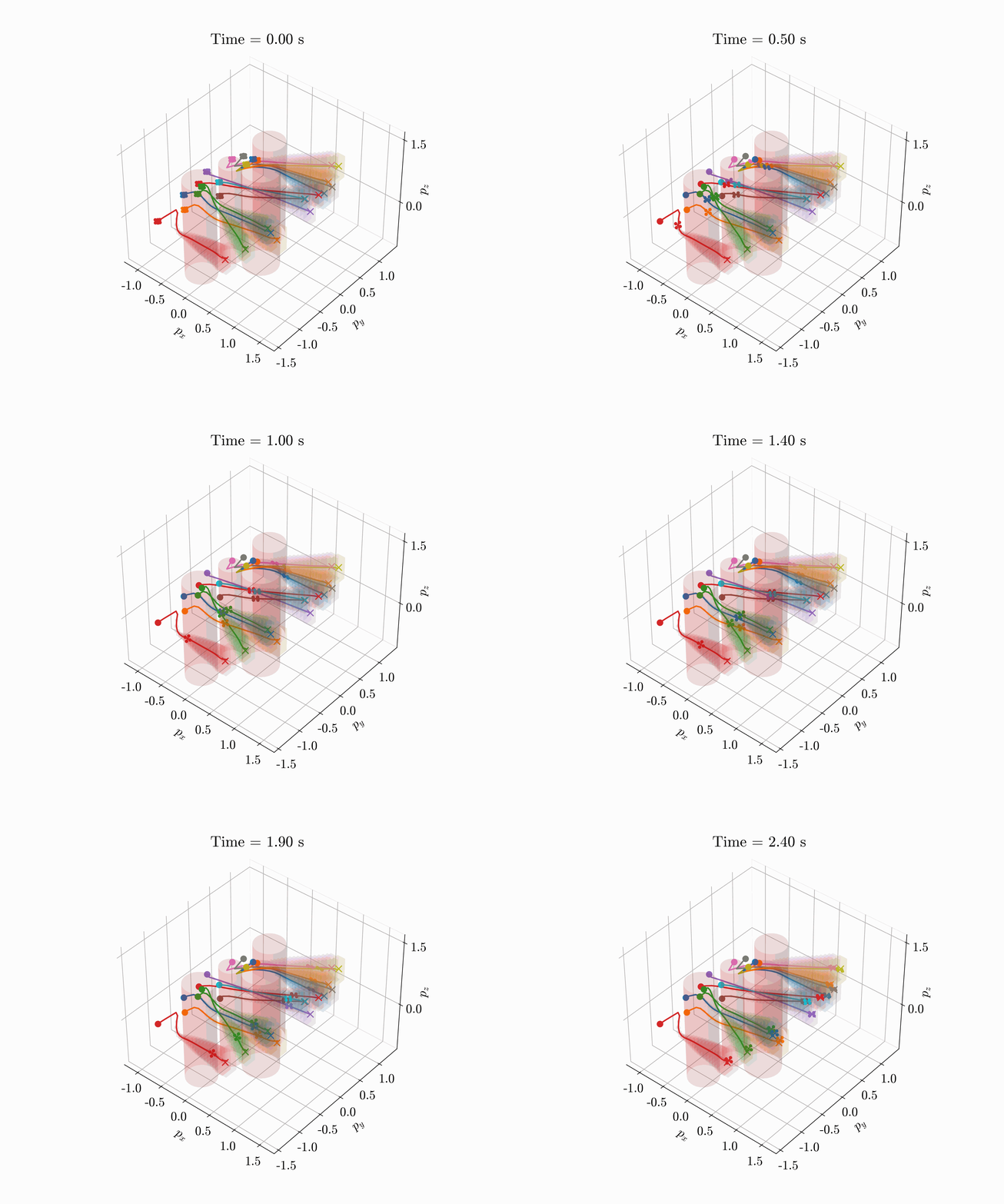
Animated multi-quadrotor rollouts with robust tubes

Rollouts and tubes

Closed-loop rollout visualization for the high-dimensional coupled quadrotor experiment.
Experiments

Analytic and Neural Dynamics Benchmarks

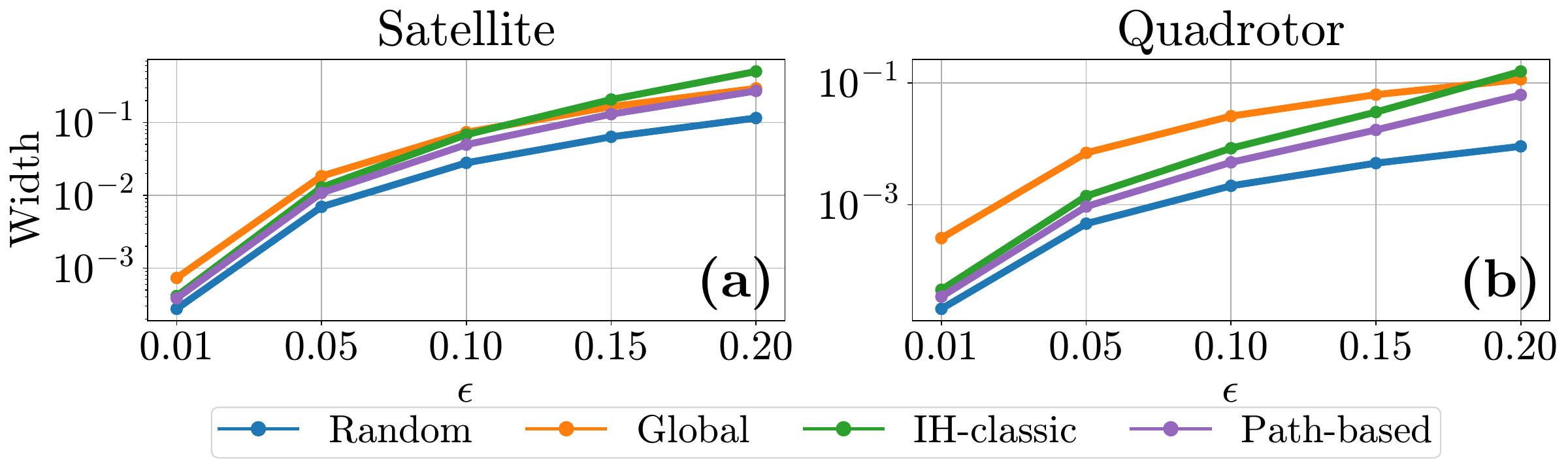
Linearization error bound comparison plots

Linearization error bounds

Path-based Hessian bounds achieve the tightest over-approximation on satellite and quadrotor systems.
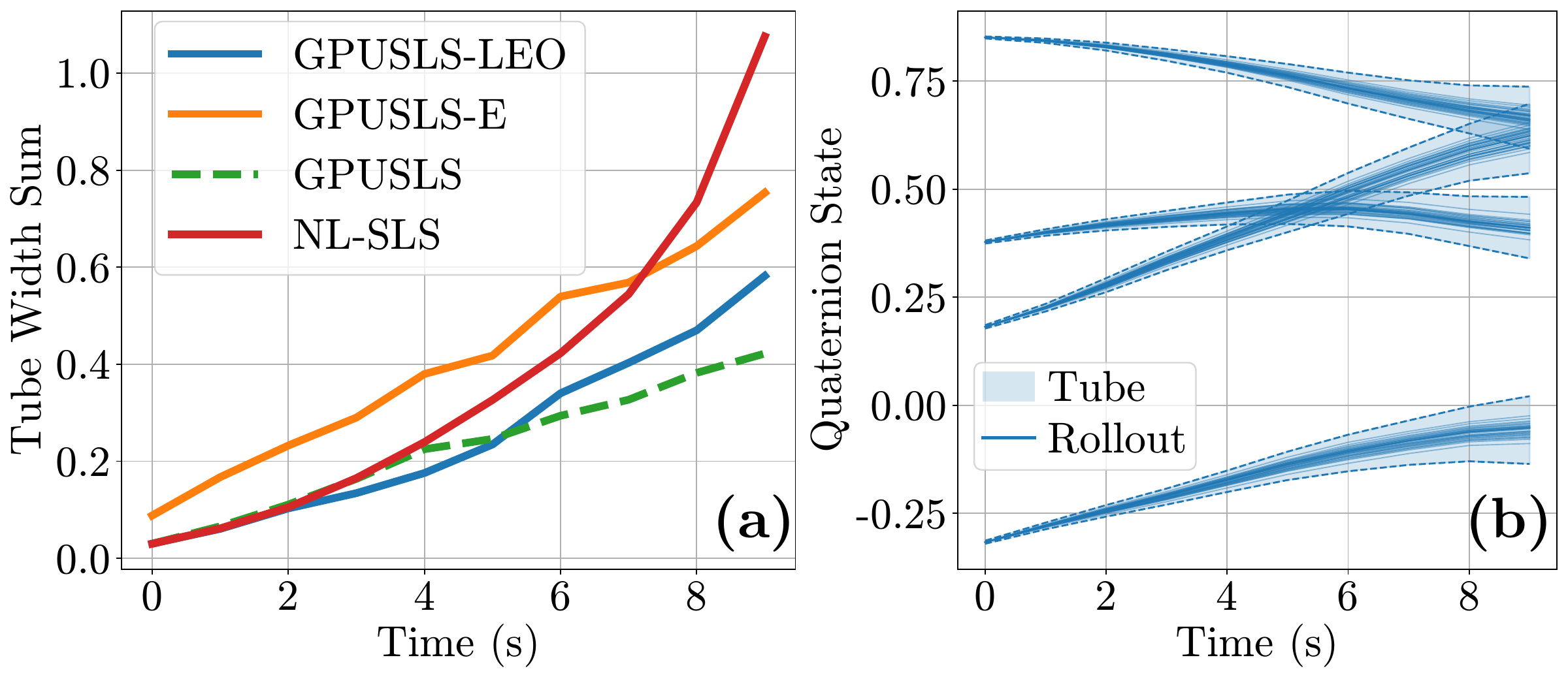
Satellite robust tubes comparison and rollout containment plots

Satellite robust tubes

GPUSLS-LEO produces the least conservative certified tubes among the paper's satellite baselines.
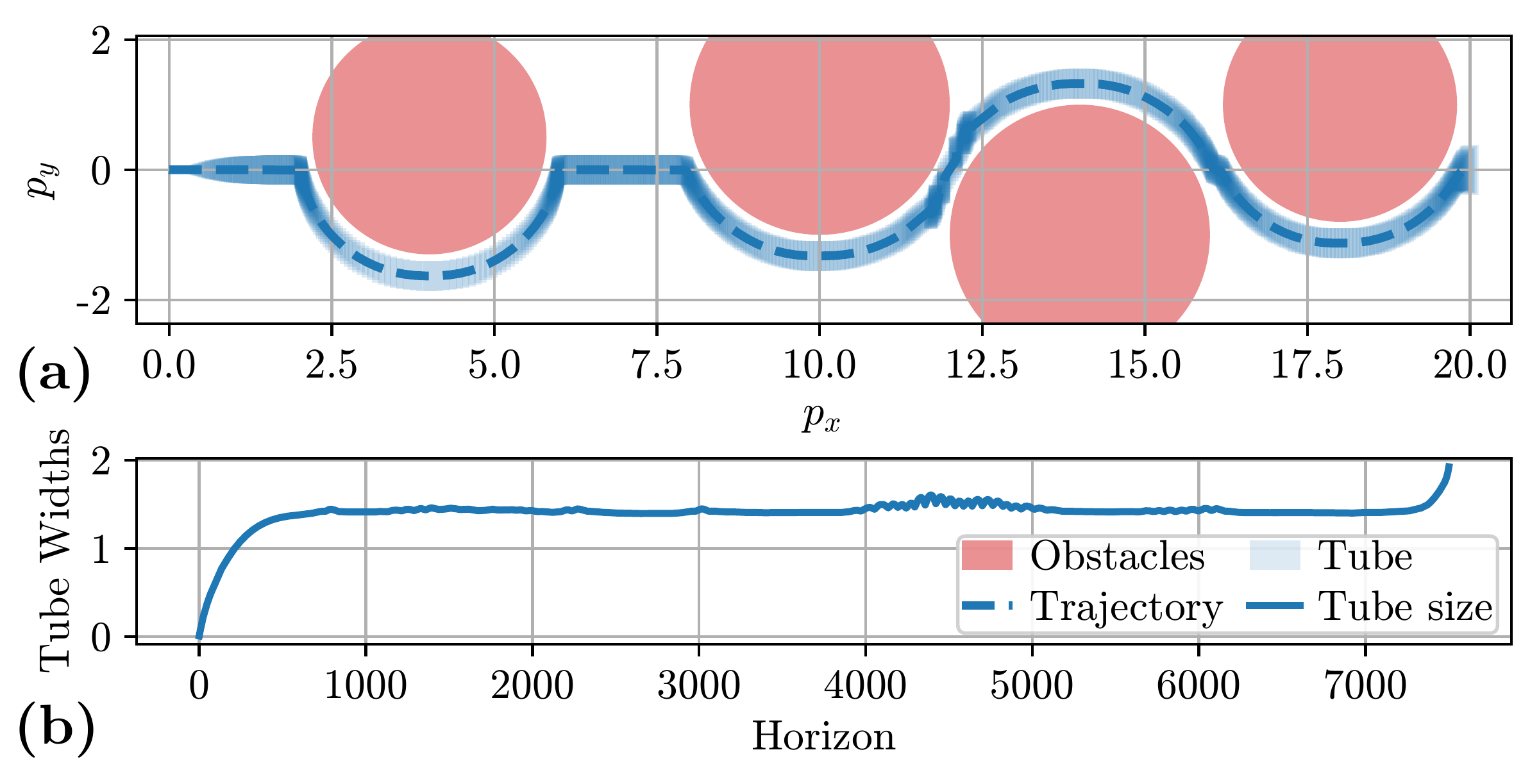
Long-horizon planar quadrotor trajectory and tube width plots

Long-horizon quadrotor

Tube widths stay bounded over a long obstacle-field trajectory by optimizing tube sizes in the controller.
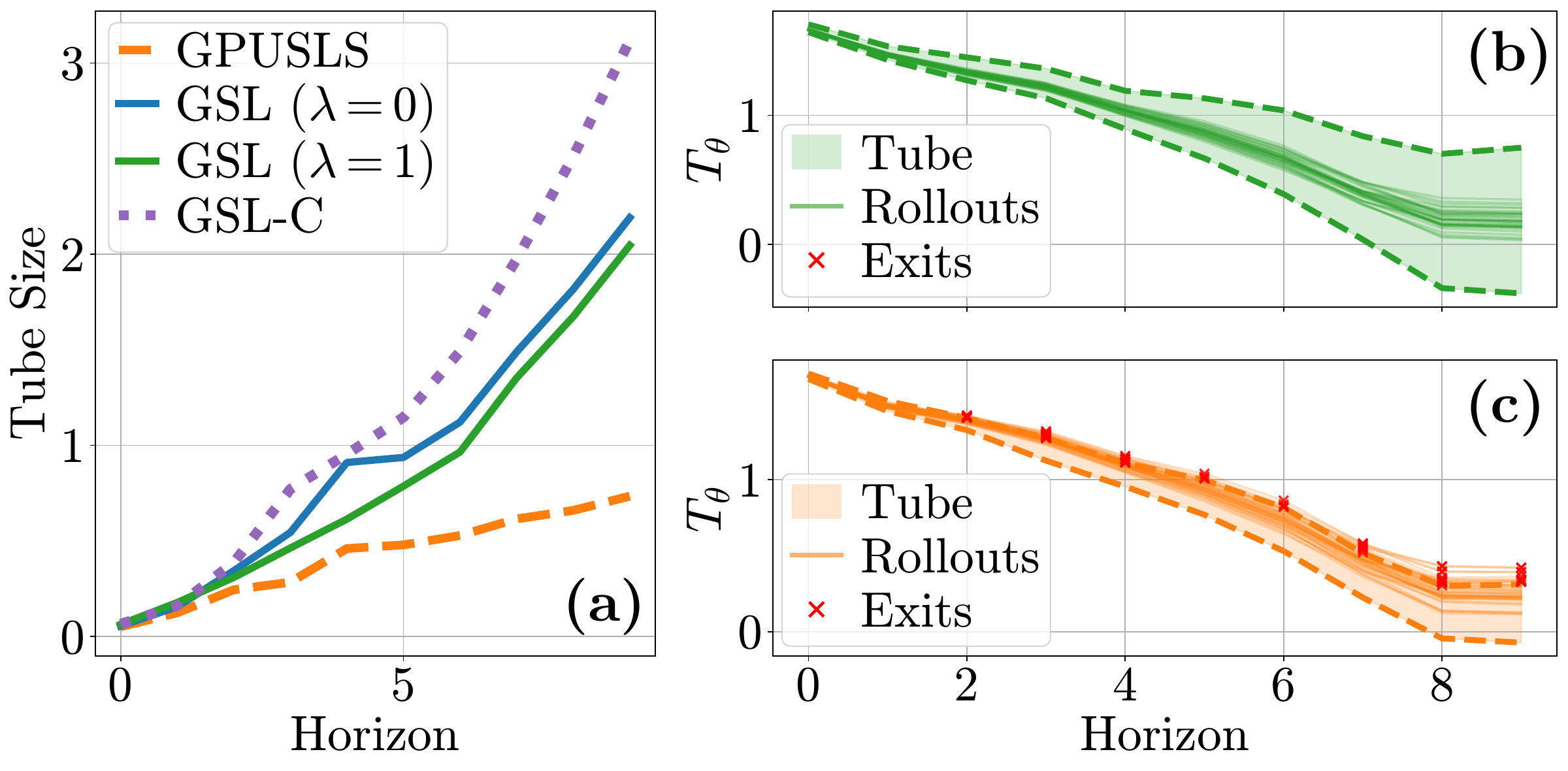
Neural T-pusher tube ablations and rollout containment plots

Neural T-pusher

Nonzero-centered tubes and linearization-error gradients reduce tube widths while preserving containment.